The Moment of Financial Independence
If you have been a client of Connect Wealth for a while, there is a high probability that you’ve built enough financial wealth that you will have more than enough money to securely navigate the remainder of life or are well on your way. It’s what’s called financial independence.
When this is achieved there is often an ah-ha moment where one realizes that they have reached this financial goal, which for many years may have seemed insurmountable. This leads to questions such as, ‘What now?’ and ‘What do I do with the excess funds?’
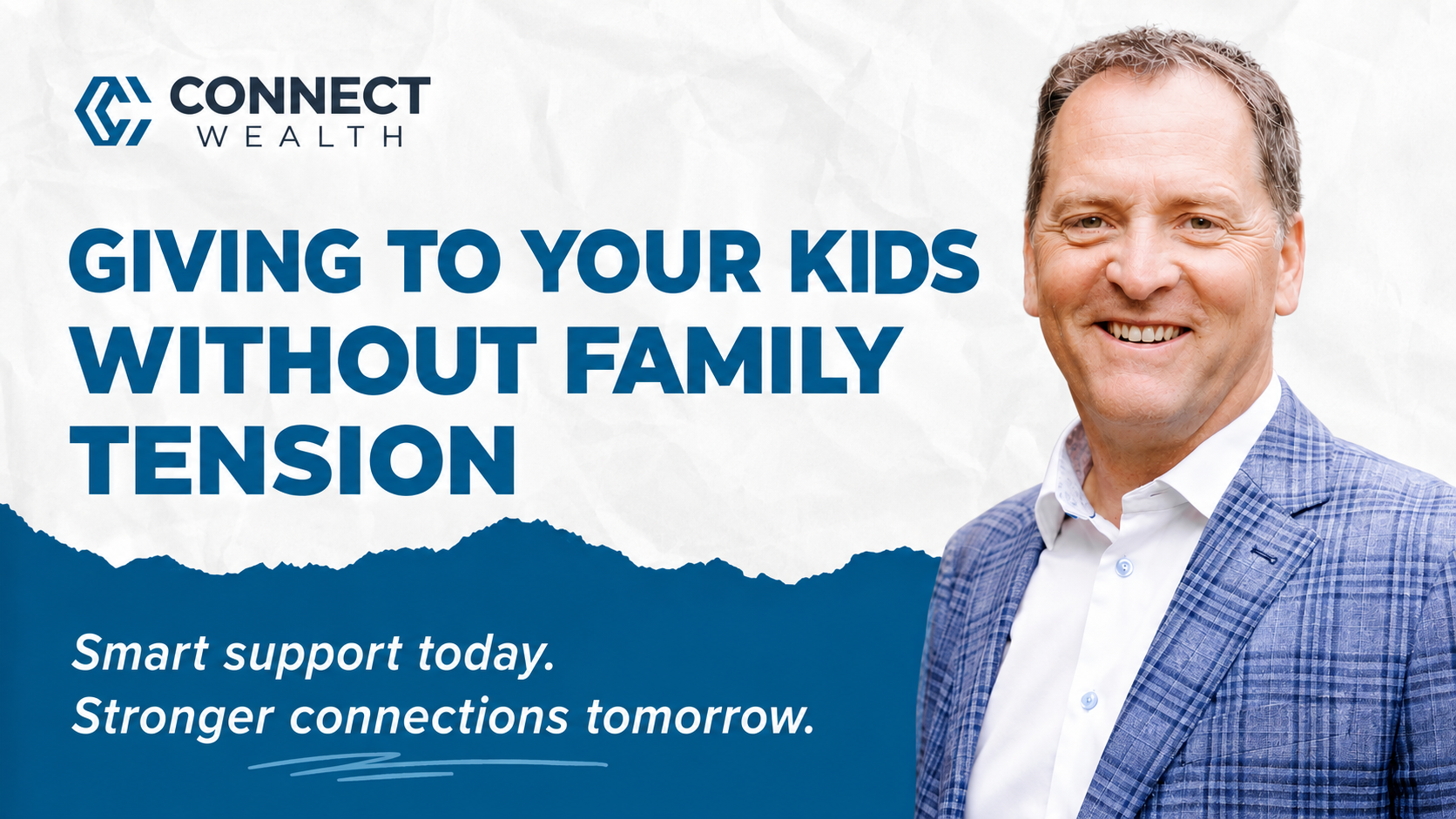
These questions can have many answers. For the purpose of this discussion, I am going to focus on one of the most common answers – “I want to use these excess funds to help my kids.”
The Two Truths Behind Wanting to Help
There are two underlying truths in this statement.
I love my kids; and
The world is harder financially than when I grew up.
These are consistent underlying values universal to clients we have had these discussions with. They want to help financially, but don’t want family wealth to fracture their families and turn it into conflict and stress in the family, now or when they are gone. Clients want to build and maintain family unity.
The Bigger Goal: Family Unity
At the end of the day, money is just a tool (a very important tool) that we use to accomplish our goals in life and align with our values. As they say, you don’t see a U-Haul being towed by a hearse.
Parents can be the glue that holds the family together. When they are gone, the glue can come undone and the fighting begins over the inheritance. When my Dad died, we met with the lawyer to walk his estate through probate. The lawyer asked us if there were any issues that needed resolving, to which we replied, No. Her reaction surprised me in that she was pleasantly surprised. I asked if our situation was unusual. She replied to the affirmative and added that many estates she sees are contentious.
This lawyer’s response is the exact opposite of what most of our clients communicate to us as their goal. Family unity is a high priority, and an inheritance must not divide the family.
Why Technical Planning Is Not Enough
Many people focus on the technical aspects such as, how the estate is structured to control and minimize tax, and how wealth is structured and diversified. While the technical things such as a will, trusts, etc., are important; their purpose is to deliver a desired end result. They are not the end in themselves.
None of the technical pieces can prevent family rifts when money is distributed to your children. The hardest part is that once you are gone, you are no longer there to explain your intentions. Technical planning matters, but there is an even more important piece that must be addressed…
The Missing Piece: Communication
Communication? Yep, there is strong agreement amongst researchers that communication is a key to successful wealth gifting and transition. It can also be the messiest part. You may think the cabin is a Family Heirloom to be split evenly with all the kids. But what if one of the kids doesn’t want to participate in this family tradition? They may feel that the other siblings are benefiting from their portion of the inheritance that they wouldn’t have chosen. This is but one example of things that can cause relational disunity.
You can’t speak from the grave, but you can speak now. Communicating with your family how and why your estate is structured the way it is can help open lines of communication now while you are still around to participate in the discussion. We have been involved in many conversations with clients where they are in the middle of an estate disagreement because of how their parents treated their kids differently, either while they are alive or once they have passed and all is revealed.
Practical Communication
There are some very practical and “easy” to implement communication plans. This list is not exhaustive but helps move things in the right direction.
No Family Secrets:
If a parent is lending/gifting money to one child and doesn’t want to communicate that with the other kids, the odds are high there will be an issue in the future. We tell clients, if money is moving to one child and not the other(s), make sure everyone in the family knows what is being done, the structure of the agreement and why.
Everything in Writing:
But we’re family! That’s right – that makes it all the more important that things are in writing. In the future, if there are differing views on what was agreed upon, there is a document to remind everyone. That agreement should be shared with all family members. Remember…no secrets. Request feedback from all family members.
Family Meetings:
I learned this lesson by accident. My dad was my mom’s caregiver for many years. One Christmas my brothers and I thought it would be wise to find out from our dad what the plan was if he pre-deceased her. So, we went out for coffee. Over that coffee, my dad walked us through what the plan was. After he shared the plan, he wisely asked a question, “do you have any concerns with this plan?” It opened the floor for discussion and debate and in the end, after ideas were shared, there were a couple of tweaks made to simplify the estate and take care of our Mom. My dad’s receptivity to feedback and not being defensive allowed us to build a better estate plan. Thank you, Dad!
Estate Details:
We never know when it’s our turn to go. It can happen suddenly. Clients often ask how they can make settling an estate easier for their families. This is a much bigger topic for another blog, but one “simple” thing you can do is have a centralized estate document.
An estate document would provide the following information which they can easily generate to take to a lawyer to start the estate settlement process. Here are items that you should include in this document:
Contact information for professionals: executor, accountant, lawyer, financial advisor etc.
Location of important documents: original location of will and when it was last updated.
List of assets:
Investments: account numbers, institutions, real estate PID numbers (property identification number)
Company ownership
List of Liabilities: lenders, account numbers, institutions
We have built an estate module that is available to our clients that can be a centralized place to store this information. You can print the estate document, and it should contain everything your executor would need to give to the lawyer. Ask us if you want to know more about how this works.
As I mentioned, this is not an exhaustive list, but hopefully it helps get things started.
Helping your children financially can be a meaningful way to use the wealth you have built. But we have learned that, for most of our clients, the goal is not simply to pass money on — it is to pass it on wisely, in a way that reflects your values and protects the relationships that matter most.
The greatest risks in wealth transfer are often not technical; they are relational. Wills, trusts, agreements, and estate documents are important tools, but they cannot replace clear communication, thoughtful preparation, and a shared understanding of your intentions.
If your desire is to help your kids without hurting family unity, start the conversation now. Be clear. Put things in writing. Avoid secrets. Invite questions. Prepare your children not just to receive wealth, but to steward it well.
In the end, the best legacy is not only the wealth you leave behind, but the wisdom, clarity, and family unity that go with it.